Reflections:
Here are my reflections on the artists we've studied this semester, along with the pieces I created for class.
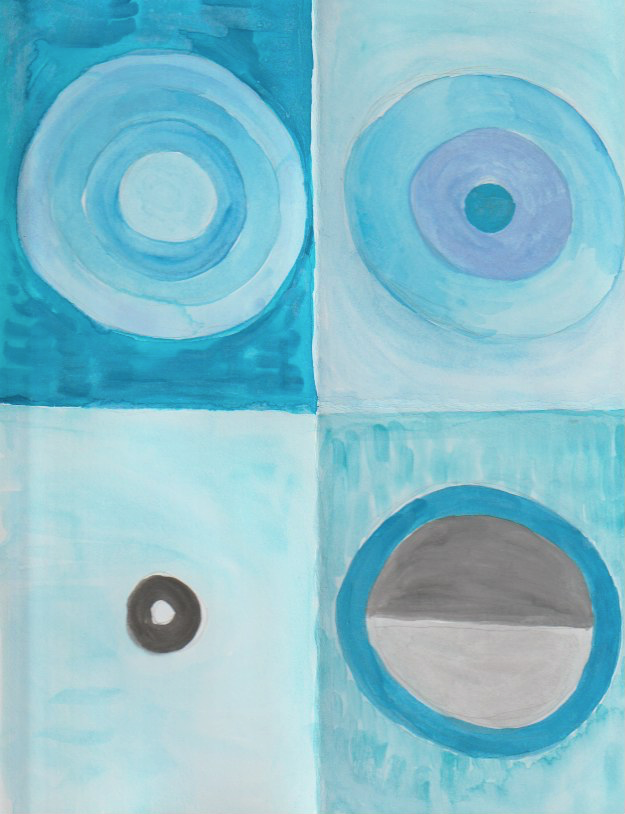
Kandinsky Reflection
I had a fun time creating this piece. The most appealing part of this project for me was thinking of ways I could make each circle unique. I love blue, black, and neutral colors which is evident in the color choices I made. I did not overthink or plan my process. I began by folding the paper into quarters, so I could make four circles in equal quadrants. Then I sketched out circles of varying sizes. My focus with this piece was thinking of ways I could insert my style and make this piece unique, while also following the instructions provided.
I personally connect to this picture through my use of color. Blue has been my favorite color throughout my whole life, and it plays a heavy role in all of my artwork. While approaching this piece, I debated whether or not I should stay within my typical art style, or if I should deviate. Ultimately, I decided to stay within the blue and neutral color palette, as it was what made me happiest.
In making this piece, I was inspired by outer space. I love stars and other celestial objects, because to me they represent curiosity for what lays beyond what we can immediately see. I saw the circles as planets and their rings.
I could ask students if they could make a story about what is happening in the picture. I could facilitate a conversation by offering a story of what I see first, so the students understand what I mean when I say “make a story.” I could ask them “who are the characters in this painting?”
Possible activities:
- I have an idea to make concentric circles using the students’ hands– the students could first dip their fist in paint, then their thumb, then their pinky finger. This would make circles of varying sizes, similar to Kandinsky’s circles.
- I also have an idea to put on instrumental music of various styles for the children (jazz, classical, techno) and ask the students to draw what they hear, using only circles. I think this would help the students to think in an abstract way, and listen to the bodily response that the music evokes in them.
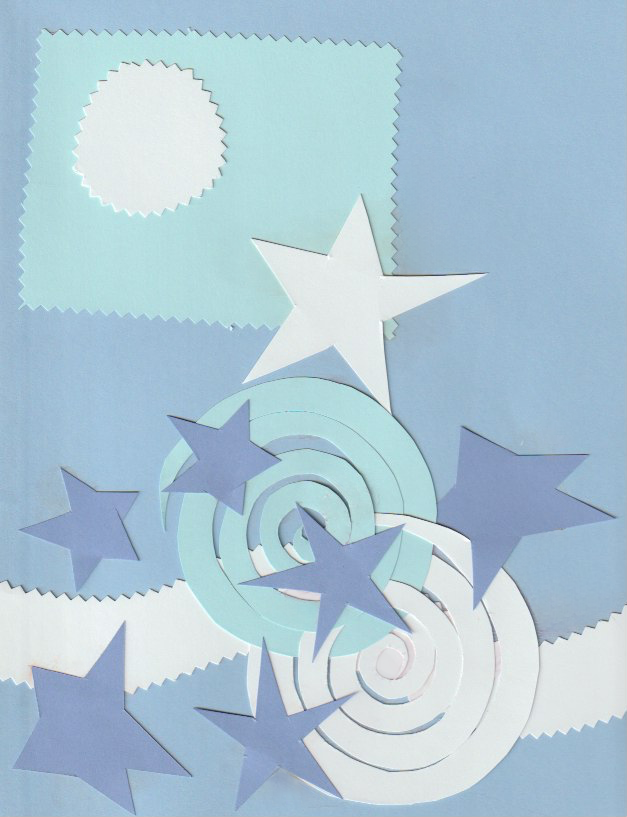
Matisse Reflection
Within this piece, my creative process was quite simple. I did not sketch out my shapes prior to cutting them out, and instead allowed my scissors to act as the pencil. I cut out stars and swirls, typing back into my celestial theme from the previous project. Once I had cut out all of my shapes, I took them in my hands, and scattered them haphazardly over the paper. I liked the way most of the shapes fell, however, I did rearrange a few of them. I also had fun adding my own twist by using scrapbooking scissors, which gave some of the shapes a zig-zag edge.I personally relate to this picture because it reminds me of scrapbooking, which was a fun hobby of mine from when I was a kid, which feels almost obsolete now with the rise of social media to showcase pictures. I loved creating something that felt very tactile and analog, in a time where art has become increasingly digital.
I was inspired by children’s books, particularly those that use a patchwork/ collage style in their illustrations. I could easily imagine the piece I made as a background to a fun outer-space scene.
In order to facilitate questions about Matisse’s work, I would ask my students how they think the piece was made, because I don’t think it’s immediately obvious that the shapes are cut-out paper. If I was unfamiliar, I might think that they are painted on.
Possible activities:
- I would ask the students to bring in photos of things they love, and make a collage of personal photos along with Matisse-esque shapes cut out of construction paper
- I would ask the students to make a collage using sight-words along with cut outs of the object the word describes. For example, cutting out the word “pig,” and pasting it next to a cut-out of a pig.
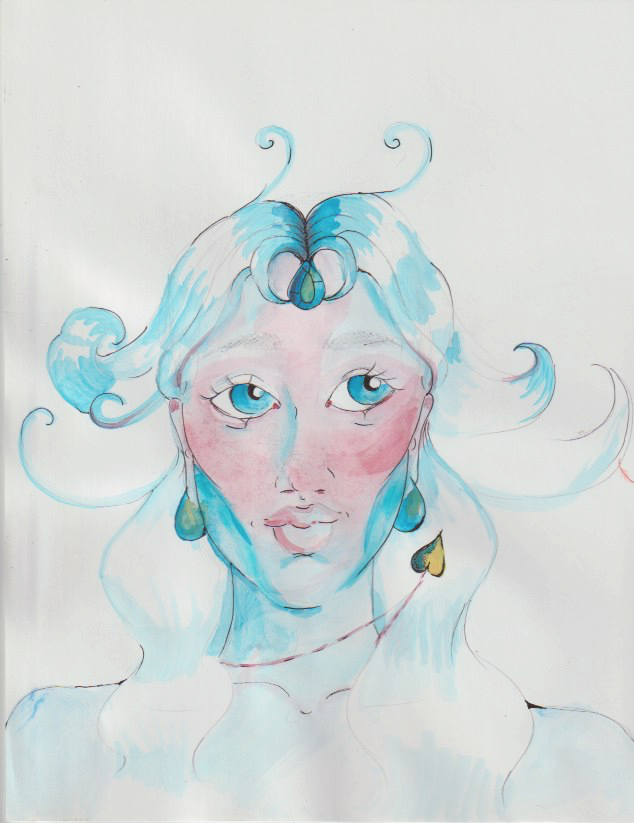
Van Gogh Reflection
This was by far my favorite piece to make for this class. I loved freely painting using only primary colors. I knew that blue would play an important role in my composition, but I was unsure how much of the other colors I would use. I knew I did not want to use all three colors equally, and that I wanted to be strategic about how much or how little I used of red and of yellow. Ultimately, I decided red would be my second most used color next to blue, as I think of them as polar opposites. I decided to use yellow very sparingly, acting only as an accent color.
I personally relate to this painting because I view it as a perfect embodiment of my style. I love creating stylized portraits of women across different mediums, with an ethereal, dreamy aesthetic. I always joke with my friends that “this is how I see myself in my head,” but I think to a degree, that is true. I love depicting women as pensive and dream-like, because that is how I think of myself. I wouldn’t say this painting is a true “self-portrait,” because it doesn’t exactly look like me, but I think it captures my personality.
I was inspired by Celtic Mythology, as I am of Irish heritage. Last year, I took a life-changing trip to Ireland, and the imagery of Celtic Goddesses started creeping into the aesthetics of my art. I love honoring my culture in my work.
When it comes to Van Gogh’s work, I would ask my students who they think the person in Van Gogh’s paintings was, without revealing that they are self-portraits. I think that through a modern lens, many people might view making this many self-portraits as vain, so I would be curious to see if children would immediately assume that the paintings were of the artist himself.
Possible Activities:
- I would ask the students to create a self-portrait, like Van Gogh, but only using recycled materials, like bottle caps and wrappers. I would ask the children to choose the materials that best represent their personality, not just their physical appearance. I think a self-portrait should show the personality of the artist rather than just physically representing what they look like, which is a skill that I believe Van Gogh embodies.
- I would ask the students to bring in a photo of themselves (or I could take a photo in the classroom on a polaroid camera) and ask the students to paint over the photo using only primary colors, similar to coloring in the lines of a coloring book.
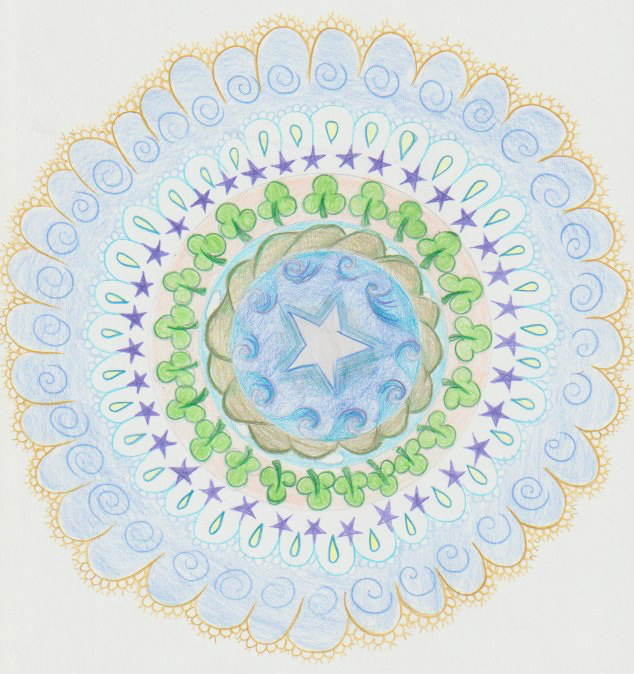
Mandala Reflection
I began making this Mandala by finding circular objects around my house that I could trace (bottle caps, cups, tupperware containers.) Then, I traced circles within circles, similar to the concentric circles project. Once that was done, I drew symbols within each circle that represented my culture and heritage. After the first few circles, I was able to draw symbols free-hand, without the help of a tracing aid. This was all colored using colored pencils.
I personally connect to this picture because I view it as a perfect representation of my culture, which is something very dear to me. While creating this, I tried to think of my own personal experiences on my solo-trip to Ireland, and what that life-changing experience meant to me, instead of just depicting stereotypical symbols of Ireland. One of my favorite facets of this piece are the hills of Ireland I drew within one of the circles. It might not be something immediately noticeable at first, and I enjoy the way I cleverly hid them inside the patterns of the mandala.
I was inspired by aspects of my culture that feel very insular to me, and trying not to make the piece obviously stereotypical. I knew I did not want to include an Irish flag, or anything that a non-irish person would associate with Ireland. I wanted to highlight the natural aspects of Ireland– the rolling hills, the greenery, the cliffs. My trip to Ireland was incredibly emotional to me, because my great grandmother had left Ireland alone at 14 years old to escape generational poverty, and I had come to Ireland on a solo-trip. Looking out at the cliffs of Mohr all by myself, I thought about the fact that my great- grandmother probably looked out at the same water all by herself, and dreamed of a better life, and I was overwhelmed with gratitude that I get to live the life she dreamed of.
As it pertains to Mandalas, I would ask my students to trace the symbols on the mandalas with their index finger, and follow the patterns with their eyes. I would ask them how they find this experience, and if it is calming for them.
Possible activities.
- Similar to how I achieved the Mandala I created, I would give the students various circular objects, and ask them to trace the objects to create a mandala.
- I would put on calm music with lyrics, and ask the students to make a mandala based on how the lyrics make them feel. I could also try this with spoken word poetry.
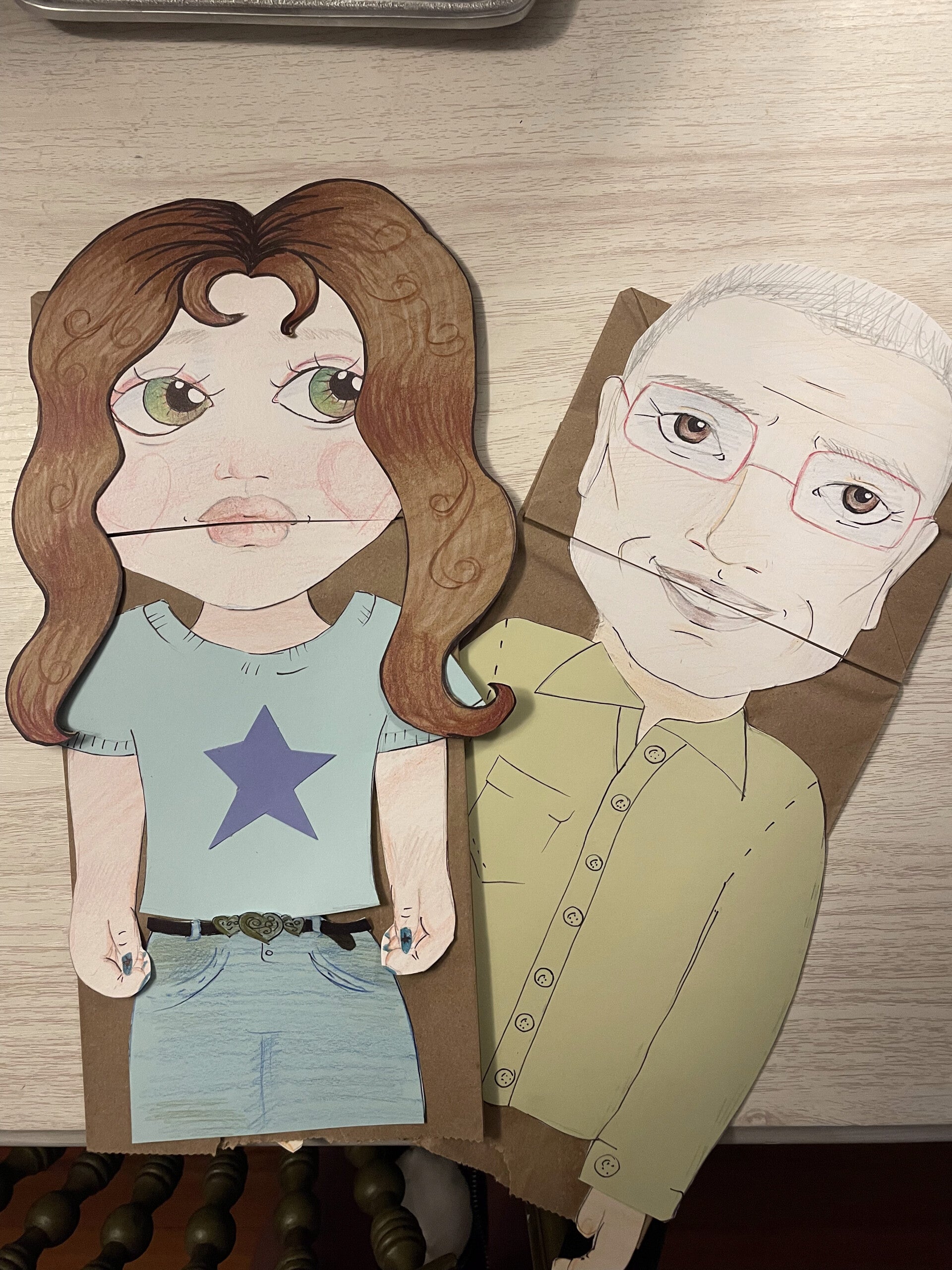
Puppets
Going into making these puppets, I had some doubts about how they would turn out, but I actually think they came out better than I anticipated. I began by lightly tracing the paper bag onto cardstock, so I knew the parameters that I had to draw within. I drew the face, hair, and clothes onto all different colors of card stock, so each component of the puppet would be vibrant and stand out from each other. Then, I cut the head straight across horizontally where the mouth was, so it could give the puppet the effect of “talking.” Then I glued all of the pieces onto the paper bag.
I personally relate to these paper bags because they represent me and a math teacher I had named Mr. Rubenfeld, who was very influential on me, because he encouraged me not to give up on math even when it was challenging for me. I loved thinking of ways to represent myself and my former teacher in a way that was fun and cartoonish, while also true to what we looked like.
I was inspired by stylized stop-motion cartoons where the artists use paper cut outs to make it look like the characters are talking. I love making animations in my free time, so I used some of those techniques in the creation of these puppets.
Some questions I could ask students would be: “What stories would you like to tell using puppets?” or “Based on a story we’ve read in class, show me how you’d change the ending, using puppets?”
Possible Activities:
- Students can make sock puppets of themselves using scraps of their own old clothes that they've outgrown. In this way, the puppet is a representation of themselves, made from pieces of the child’s life.
- The teacher can read half of a book to the students, and then task them with creating puppets of the characters, and putting on a puppet show where they create their own ending.
Create Your Own Website With Webador